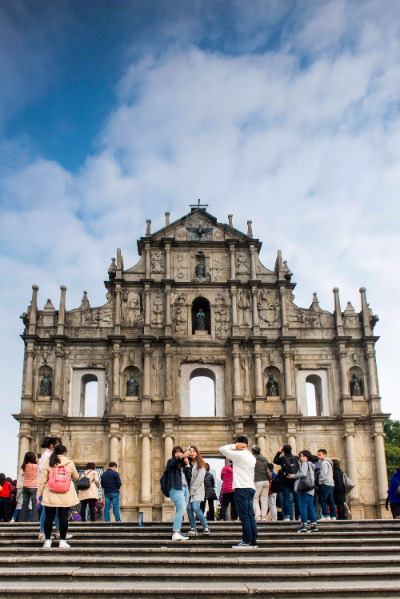
Ruins of St. Paul's
Introduction
The Ruins of St. Paul's stand as one of the most iconic landmarks in China's Macao Special Administrative Region (SAR), representing the rich historical tapestry and unique cultural blend of the region. Today, the Ruins of St. Paul's are recognized as a symbol of the city, encapsulating its historical and cultural significance.
Macao, a place where Eastern and Western cultures have coexisted for over 4 centuries, is a testament to the exchange and fusion that occurred due to its strategic location as a port and gateway into China. The Ruins of St. Paul's are not just a historical site but a cultural emblem of this enduring fusion. The façade itself is a masterpiece of baroque/mannerist architecture, unique in its design and style with a harmonious blend of European baroque influences and distinctively oriental motifs. It is an epitome of the cultural interchange between Europe and Asia, recognized for its universal value by UNESCO.
History
Construction and Expansion
The Ruins of St. Paul's refer to the façade of what was originally the Church of Mater Dei, which was built between 1602 and 1640, and the ruins of St. Paul's College, which stood adjacent to the Church, both were destroyed by fire In 1835. As a whole, the old Church of Mater Dei, St. Paul’s College, and Mount Fortress can be perceived as the Macao’s “acropolis”, and were all Jesuit constructions. The Jesuits, known for their missionary zeal, established this site as a bastion of religious and academic pursuits. St. Paul's College, in particular, acclaimed as the first Western-style university in the Far East, providing an extensive curriculum ranging from Theology to Astronomy. This educational institution was pivotal in training missionaries who would spread Roman Catholic teachings throughout the region, including China and Japan.
Destruction and Preservation
In 1835, a devastating fire consumed much of the Church of Mater Dei and St. Paul’s College, leaving only the iconic façade standing. This façade, however, has survived as a symbol of resilience and historical continuity. Over the years, efforts have been made to preserve the Ruins of St. Paul's as a historical monument. Today, it serves as a popular cultural and tourist destination, attracting visitors from around the world who come to witness its magnificence and historical significance.
Architecture
The architectural design of the Ruins of St. Paul's is an extraordinary example of mannerist style, infused with baroque elements. The façade measures 23 meters across and 25.5 meters high, and is divided into 5 levels, each reflecting a classical progression towards divine ascension. The orders on the façade evolve from Ionic at the base, through Corinthian, to Composite at the top, symbolizing this journey. The triangular pediment at the apex represents the Holy Spirit, capturing the ultimate state of divine ascension. This blend of classical and spiritual symbolism is further complemented by oriental decorative motifs, including Chinese characters, chrysanthemums, and mythological representations, creating a unique fusion of Western and Eastern design elements.
The Ruins of St. Paul's were constructed primarily from granite, a choice that has contributed to the longevity of the façade despite the destructive fire that consumed much of the rest of the Church and College. The use of granite also allowed for the intricate detailing that characterizes the façade, from the biblical and mythological sculptures to the nautical motifs and representations of Jesuit saints. The durability of the stone has ensured that these features remain visible and continue to tell the story of this historic site.
Cultural Significance
The Ruins of St. Paul's hold immense cultural significance as a symbol of Macao's unique heritage. As part of the Historic Centre of Macao, a UNESCO World Heritage Site, The Ruins of St. Paul's are part of the evidences of the city's role in facilitating cultural and intellectual exchange between Europe and Asia. The iconic façade is more than just an architectural marvel; it is a cultural altar to the city, symbolizing the diverse and rich history of the region. The site also reflects the broader interchange of scientific, artistic, and cultural ideas, facilitated by the Jesuits' missionary activities throughout Asia.
Tourism and Accessibility
As one of Macao's most famous landmarks, the Ruins of St. Paul's attract thousands of visitors each year. The site is easily accessible, situated close by the miniature Na Tcha Temple, and forms part of a walking trail that includes several other historical sites in the city. The Ruins of St. Paul’s serve more than a historical monument, it's a hub for cultural events and activities, improving their appeal to both local residents and international tourists.
Conservation Efforts
Efforts to preserve the Ruins of St. Paul's have been an ongoing commitment by the local authorities and international preservation bodies. Recognizing the site's cultural and historical importance, these efforts have focused on maintaining the structural integrity of the façade, preventing further deterioration, and ensuring that the site remains safe and accessible for visitors.








